
- A CTO does three jobs: setting technical direction, running delivery, and providing credibility. A fractional CTO does the first and third well. The second needs someone present every day.
- Before you have a product, you need direction, not a full-time executive. Before you have an engineering team, you do not need someone to run one.
- The switch to full-time is usually triggered by team size (five or more engineers), by delivery becoming the bottleneck, or by a funding round that expects a named technical leader.
- The wrong hire in either direction is expensive: a full-time CTO with nothing to run leaves; a fractional CTO stretched across a fifteen-person team becomes a bottleneck.
- Sometimes the answer is neither yet. An experienced senior engineer plus a technical advisor covers more than founders expect.
The three jobs a CTO actually does
"CTO" describes a title, not a job. In practice the role bundles three different jobs, and the fractional-versus-full-time question becomes clear once they are pulled apart.
Direction. Deciding what to build and how. Architecture, technology choices, build-versus-buy calls, security posture, the sequencing of the technical roadmap against the business roadmap. This is judgment work. It happens in decisions, not in hours.
Delivery. Getting it built. Hiring engineers, running the team, unblocking people, reviewing work, setting standards, handling the day-to-day of an engineering organization. This is presence work. It scales with headcount and it needs someone in the room, or at least in the chat, every day.
Credibility. Being the technical face of the company. Sitting in investor meetings and answering the hard questions. Closing senior hires who want to know who they will report to. Passing enterprise due diligence. This is trust work, and it depends on the person's track record more than their hours.
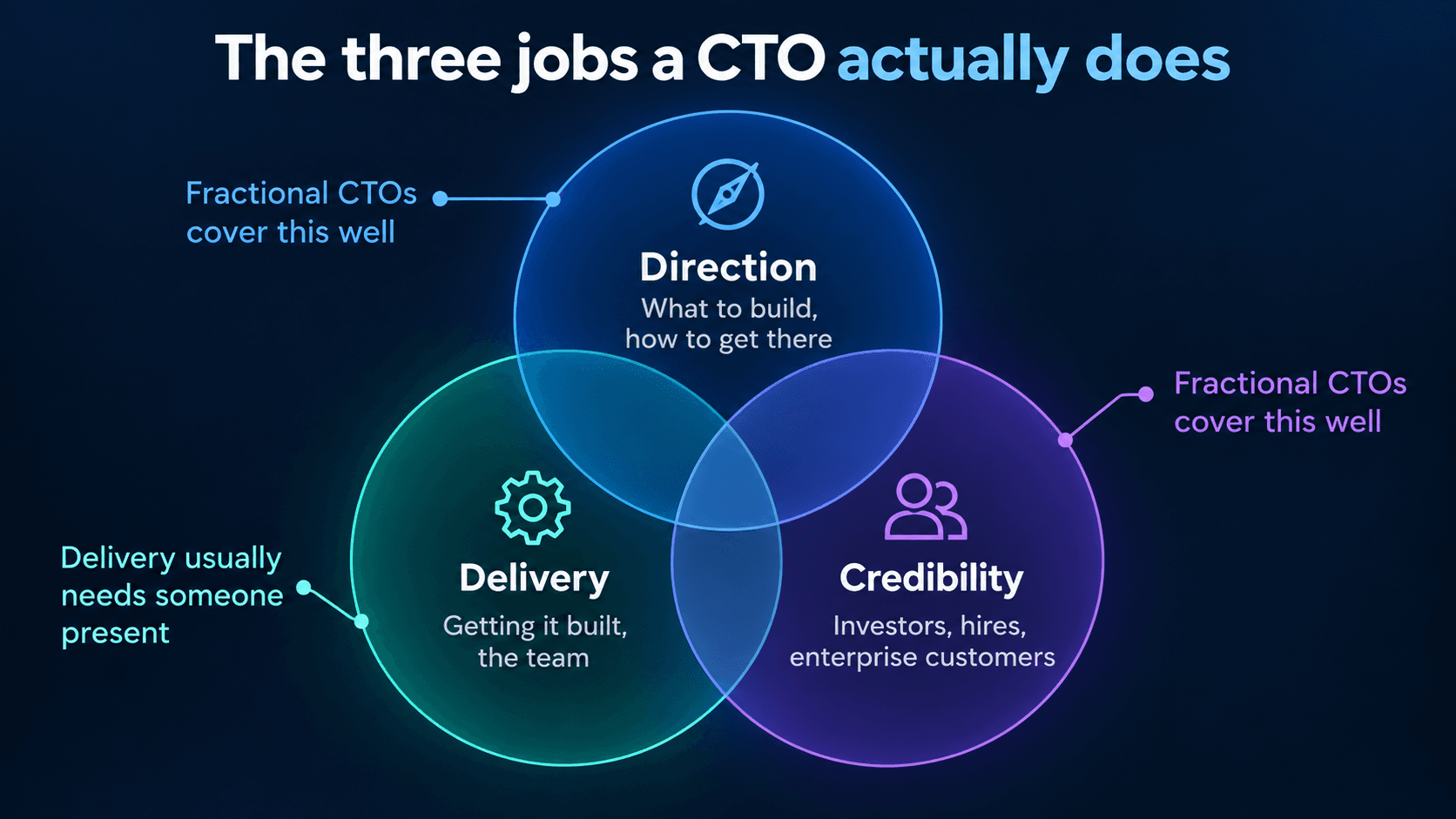
A fractional CTO covers direction and credibility well. They can set the architecture, make the decisions, sit in the investor meeting, and review the due-diligence questionnaire. What they cannot do, on two days a week, is run a team of twelve. Delivery is the job that forces the full-time hire.
What a fractional CTO is for
A fractional CTO is a senior technical leader who works with your company part-time, usually a fixed number of days per week or month, often across two or three companies at once.
The model exists because most early-stage companies need senior technical judgment far more than they need senior technical hours. A pre-seed startup with two contract developers does not have forty hours a week of executive-level decisions to make. It has perhaps four hours of them, and they matter enormously. Paying for forty to get the four is how a company burns a seed round on a title.
The right fractional CTO gives you the decisions without the payroll. They also give you something a full-time hire often cannot at that stage: pattern recognition from having done this several times before. A CTO who has taken three companies from prototype to series A knows which corners can be cut and which cannot. A first-time CTO is learning that on your budget.
What a fractional CTO is not is a part-time engineer. If what you actually need is someone to write code, a fractional CTO is the most expensive possible way to get it. Hire a senior engineer instead.
What a full-time CTO is for
A full-time CTO is for when delivery becomes the job. When there is a team to run, when the hardest problem is throughput and quality rather than direction, when the technical organization needs someone whose entire attention it has.
It is also for when credibility has to be permanent. Some investors will not fund a technical company without a full-time technical co-founder or CTO on the cap table. Some enterprise customers will not sign with a vendor whose technical leadership is shared with two other firms. When the business reaches those conversations, the fractional model has done its job and it is time to convert.
The full-time hire is expensive in ways beyond salary. Equity, most obviously. But also the cost of getting it wrong: a full-time CTO who turns out to be a poor fit is a six-to-twelve-month problem to unwind, with the team's morale and the roadmap both taking damage. A fractional engagement that is not working can end next month.
A stage-by-stage answer
| Stage | What you have | What you need most | Model that fits |
|---|---|---|---|
| Idea / validation | A founder, maybe a designer, no code | Someone to tell you what is feasible and what it will cost | Technical advisor, a few hours a month |
| Building v1 | Contractors or 1–3 engineers | Direction: architecture, stack, scope, vendors | Fractional CTO |
| First customers | 3–5 engineers, real users, real bugs | Direction plus early process; credibility for the seed or A round | Fractional, or transition to full-time |
| Scaling | 5+ engineers, hiring, a roadmap that outruns the team | Delivery: running the org, hiring, standards | Full-time CTO |
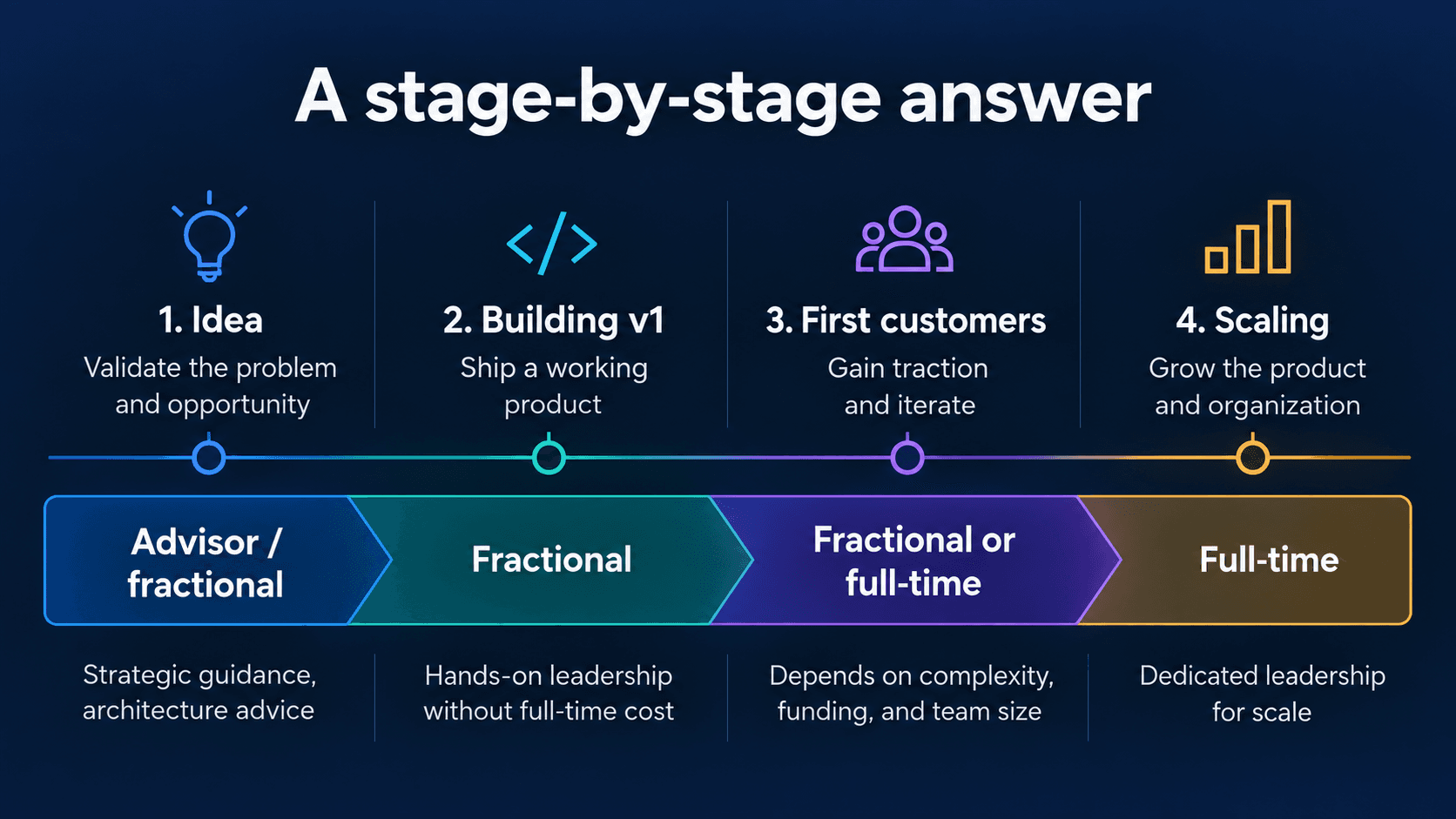
The line between the third and fourth rows is where most companies get the timing wrong, in both directions.
The signals that it is time to go full-time
The team has passed five engineers. Below that, one senior engineer can act as tech lead and a fractional CTO can set direction. Above it, someone needs to own the team full-time, and if that person is not the CTO it is a de facto engineering manager without the title or the authority.
Delivery is the bottleneck. If the company knows what to build and cannot build it fast enough, the problem is throughput, and throughput is a full-time job.
The fractional CTO is becoming a bottleneck. When engineers are waiting on decisions because the person who makes them is only in on Tuesdays and Thursdays, the model has stopped fitting. This one is easy to spot and easy to ignore.
A round is closing that expects a technical leader. Ask the lead investor directly. Some are fine with fractional through series A. Some want a full-time CTO before they wire the money. Find out before it becomes a term.
Enterprise deals need a technical executive. Security questionnaires, architecture reviews, and vendor risk assessments increasingly want to talk to the person accountable for the platform, and they want that person to have one employer.
The signals that it is too early
There is no engineering team to run. A full-time CTO with two contractors and no hiring budget will spend most of their week doing work a senior engineer would do for half the cost, and will start looking for a real CTO job within the year.
The product is not defined yet. If the company is still working out what it is building, a full-time technical executive is being asked to lead a march in a direction that has not been chosen. Direction-setting is exactly what a fractional or advisory arrangement is for.
The main motivation is optics. Having a CTO on the website is not a reason to hire one. Experienced investors and customers see through a title with nothing behind it faster than founders expect.
You cannot evaluate the hire. A non-technical founder hiring a full-time CTO with no technical input is the single highest-risk hire the company will make. If this is your situation, a fractional CTO or advisor whose first job is helping you make that hire is often the right first step.
The option most founders overlook
A third arrangement covers more ground than it gets credit for: a strong senior engineer or tech lead on the team full-time, plus a technical advisor or fractional CTO for direction and credibility a few hours a week.
The senior engineer runs delivery day to day, which is the job that needs presence. The advisor makes the architecture calls, reviews the big decisions, joins the investor meetings, and, importantly, helps evaluate and eventually recruit the full-time CTO when the time comes. For a company between two and eight engineers, this is often the cheapest arrangement that does not compromise on anything that matters.
It also solves the founder's original problem: it puts someone with judgment in the room for the hire the founder cannot evaluate alone.
Making the fractional model work
If you go fractional, three things determine whether it works.
Fixed, predictable time. Two days a week, or a set number of hours per month, on a schedule the team knows. "Available when needed" becomes "never available when needed."
Real authority. A fractional CTO who has to escalate every decision to the founder is an expensive consultant. Give them ownership of the technical decisions within an agreed scope.
A defined end state. Agree at the start what "done" looks like: a full-time hire in place, a certain team size, a funding milestone. A fractional engagement without an exit tends to drift into a permanent part-time role that fits nobody.
Where we fit
Our fractional CTO and technical advisory work is built for the middle rows of that table: companies that need senior direction and credibility now, and a clear path to a full-time leader later. We will also tell you if you are earlier than you think and a few advisory hours a month is enough. If you are weighing this decision, book a conversation and describe where the company is; the first thing we will do is tell you which row you are in.